

 by
by 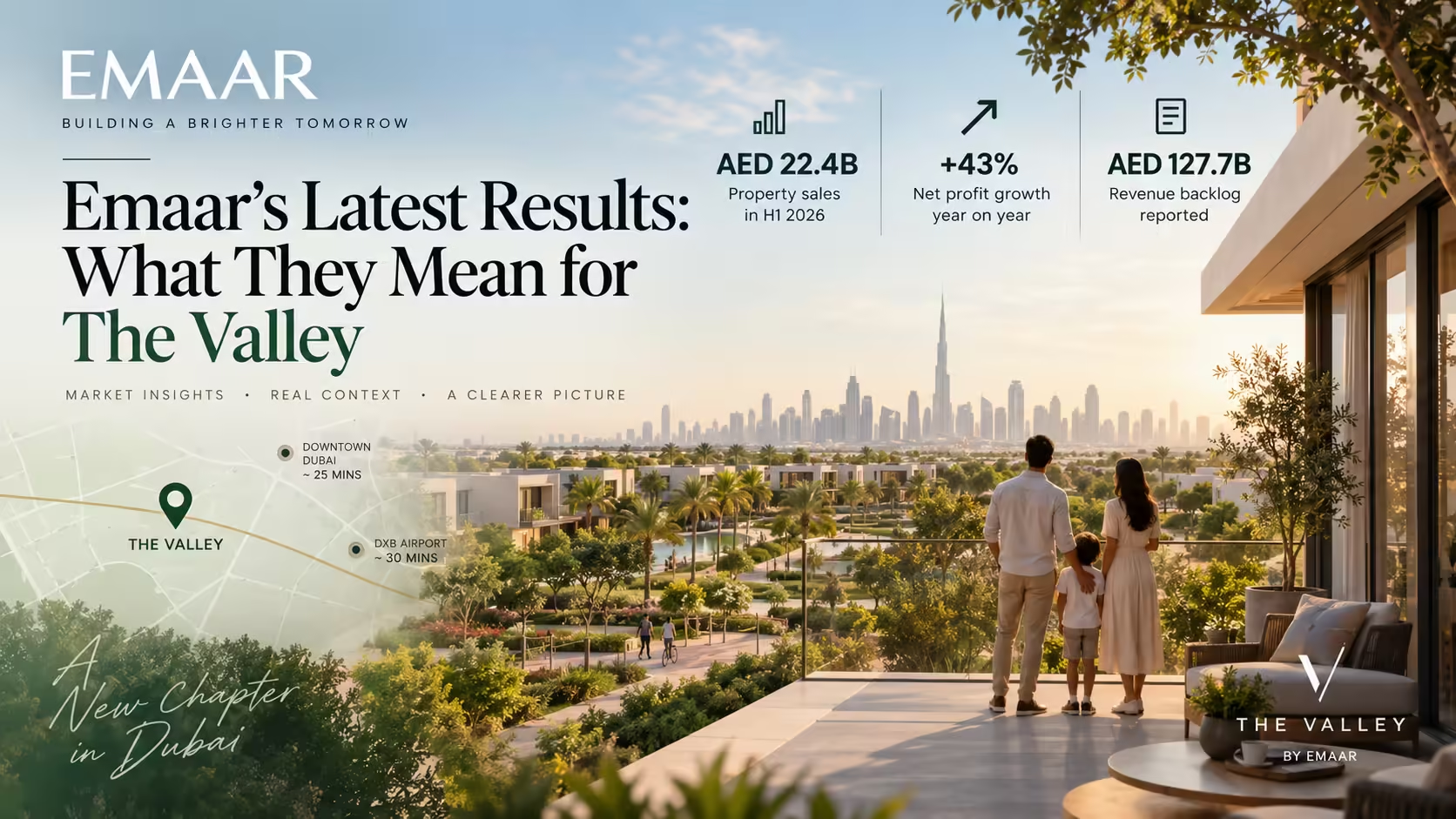
Emaar’s latest results: what should Valley buyers actually watch?
Emaar Development reported strong first-half sales and profit growth. But a developer’s financial performance is not the same as a guarantee of property returns. Here is how to read the update through a buyer’s lens.
A strong first half. A different question for buyers.
Emaar Development’s 7 August 2026 announcement gives us three useful signals: sales, profitability, and the backlog of contracted revenue. These describe the developer’s business performance—not the price of any individual home in The Valley.
Read the official announcement →
What changed in the numbers?
The clearest way to understand the reported growth is to follow one measure at a time. This chart focuses on net profit, rather than combining different financial measures on one scale.
H1 2026 net profit was reported as AED 6.7B, up 43% year on year. The H1 2025 value is calculated from the reported growth rate and rounded to one decimal place. It is not a separately reported figure.
What the chart tells you: Emaar reported higher net profit in H1 2026. What it does not tell you: whether a particular townhouse is underpriced, what its future rent will be, or whether every cluster will perform equally.
Where The Valley fits into Dubai
The Valley is positioned along Dubai–Al Ain Road, outside the high-density core. Its appeal is the combination of suburban residential space and access to Dubai’s wider road network.
For buyers, the location question is personal: the same commute can be convenient for one household and impractical for another. A map is useful for understanding the setting, but actual travel times should be checked for the buyer’s own route.
Explore Emaar’s community information →
Schematic map for orientation, not a live navigation map or a measured travel-time map.
What matters more than the headline?
Strong developer results are useful context. The actual purchase decision still comes down to the property, the community, and the numbers behind that specific deal.
| Question | Why it matters |
|---|---|
| 1 · Unit Is the property right? |
Plot size, layout, orientation, privacy, and the position within the cluster can change the value of two similar homes. |
| 2 · Location How does the setting work? |
Road access, nearby facilities, internal roads, and the buyer’s daily commute should be evaluated together. |
| 3 · Timeline When will it be ready? |
Construction progress, handover expectations, and the buyer’s own move-in or investment horizon affect the decision. |
| 4 · Price Is the deal sensible? |
Compare the asking price with recent comparable transactions, expected costs, and the intended use of the property. |
The market story is useful. The property story is personal.
Emaar’s H1 2026 results show a developer reporting strong sales and profitability. That is relevant background for anyone following The Valley, but it should be treated as context—not as a promise of capital appreciation or rental yield.
The most useful next step is to connect the broader market update to the actual home being considered.
Before you make an offer
Looking at a property in The Valley?
Let’s compare the unit, location, and current market evidence.
Join The Discussion